

war only happens at night
For oil, close-to-close volatility is a peacetime measure

Friends,
If you are reading this from the safe little life you inhabit, you are already desensitized to the US-Iran ceasefire peek-a-boo. If you accuse me of callousness to compare violence to a children’s game I’ll blame it on out-of-sight, out-of-mind distance and the limits of attention. But callousness is often just that as opposed to intentional venom so guilty-as-charged. Throw your stones.
There is (I think) minority view that the rhetorical whiplash has a profit motive. There’s the taco-flavored version which favors peace not for any strategic or humanitarian reason but because asset prices prefer it. This is the populist interpretation, if the everyman it hopes to appease is the retired boomer who’s overweight stocks because Trump’s a good businessman and will make shares rise.
There’s also the less egalitarian profit motive in that timing ceasefire game-on and game-off news coincides with less liquid and more easily manipulable oil futures markets. The news that Trump has made $1.4B in income from crypto, while BTC has been halved, doesn’t inspire a ton of confidence in the White House compliance department. (Of course, that news is not really information insofar as information is defined as a surprise or material Bayesian update to a prior.)
This pattern or at least its vibe is almost a meme on twitter. Of course, when I want to dig up tweets from sensible accounts recounting the moves I can’t remember them and Grok only surfaces bot-quality examples:
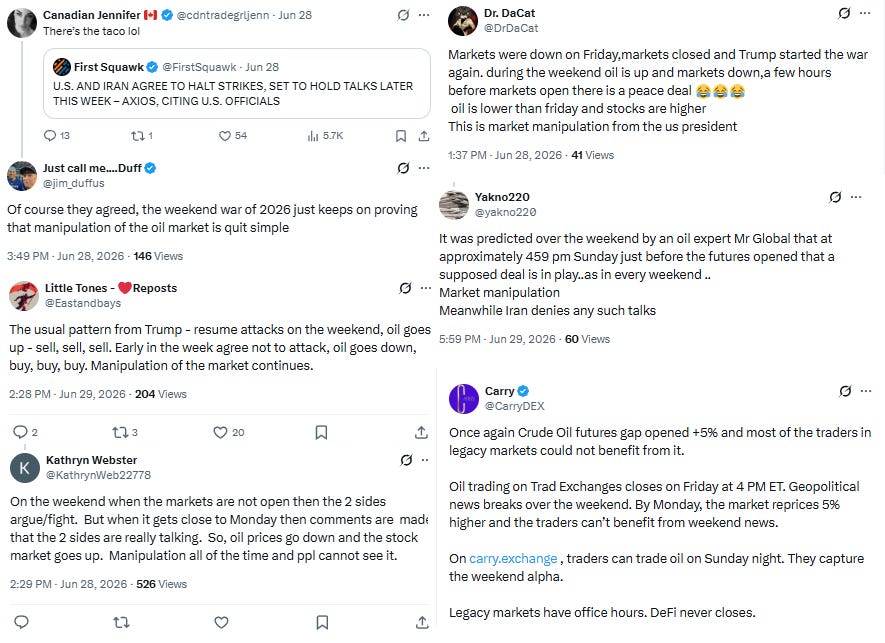
Whether there is manipulation or not is a matter for the CFTC (which is now a dictatorship, by the way, so don’t hold your breath on discovery), but the pattern is real. Recall this outstanding interview with Onyx, the world’s largest oil market maker, founder Greg Newman:
The oil market historically has been quite orderly around its market hours. But after 7:30pm our time — which is the US close, up to maybe 6pm their time — that window is meant to be dead. It’s meant to not really trade, and it’s been very, very active around these times. So now we’re doing the hours later on, to see what’s going on, because the order book will reveal things. If you’ve got the visibility of all the contracts, that’s where you’re in the best position to know: has someone selected something in particular, and what could that mean? Because there’s no other reason why you would trade at that time. If you want to hedge, you go for the peak times. If you want to speculate, you want liquidity, so again you go for peak times. So why are you trading in these evening-to-nighttime trades? It makes no sense, other than maybe you’ve just got the information. And I think Trump knows that as well, because he makes a lot of his announcements either on the weekend — when the market will gap up or down — or at night. And we’re forced to be very ready up until the actual close of the exchange now, rather than the close of the market day.
This is where my interests turn predictably dorky.
What does this mean for pricing oil options?
Thanks for asking.
It brings us to a familiar topic for long-time readers:
variance time
I’m not going to re-hash all the theory. For review you can watch this:
If you want more detail, you can read these:
Understanding Variance Time — translating between 252-day vs 365-day models and the idea of dirty vs clean vols.
The Dirties Are Down, the Cleans Are Up — cleaning implied vol of the calendar’s day-count artifacts
Weekend Theta — how a weekend actually decays, and how wall time and voltime diverge strongest when the market is closed
Pricing 0DTEs — the same clock questions at the daily / intraday scale.
In this post, we:
see how the overnight and weekend’s share of asset price volatility has changed by looking at data across liquid ETFs. The oil pattern jumps off the page, it is not just vibes.
explain how these effects bias the IV artifacts (ie the changes in IV that come from the imperfect day count in your chosen model)
suggest what this means for pricing 0dte
give you a web-based notebook so you can choose your own dates and tickers to compute what the overnights and weekends have been “worth”
