

Slam! Da duh duh!
Moontower Munchies #156

Friends,
Guitar and commencement speech. Yes, please. This was great:
📺How the World’s Largest Oil Derivatives Trading Firm Is Navigating the Iran War | Odds on Open
I’m biased considering I traded oil options for nearly 20 years but this interview is pure heat. Ethan Kho’s sat for a lengthy interview with Greg Newman, co-founder of Onyx, the world’s largest liquidity provider in oil.
Let’s go right to the excerpts (emphasis mine).
Interviewer: The oil markets have been crazy recently. How do I make sense of it all?
Greg: Honestly, I’d argue to begin with that it’s not like you should know something. There have been many crises, but this is unprecedented, and as a trader in particular it’s been very, very difficult.
There are so many oil contracts and so many liquidity pools out there. Brent and WTI are the key contracts that most traders and finance people know — that’s really the pool people dip into to hedge. But even that market, which is normally super liquid, has had its basis completely break down for a lot of these hedges. We’re used to at least one, two, three cents bid/offer, deep liquidity, lots of high-frequency traders, all that. We’re now talking 50 cents per barrel bid/offer minimum. And as you’re hedging, the price swings dollars per barrel at a time. It just breaks the whole system, because so many things in the oil world — all the contracts for every different product around the world, every region — ultimately link back to those core liquidity pools. When everything is broken from that sense, it’s incredibly hard to get a handle on it. So speculation has, to some extent, been out of the water. It’s been very difficult to do… What’s actually going on in the physical market gets reflected in these more niche contracts, of which there are many, many more, but they’re less liquid. That’s our specialty. Unless you’ve had exposure to those, it’s probably been very difficult to get an accurate reflection of what you should really be trading to profit from this.
How Onyx manages process when liquidity breaks down
Greg: We are market makers. There’s obviously a proprietary element to that, as you and your audience know very well. The temptation always is to combine your market making, look for some arbitrage-type opportunities, and then layer a discretionary element on top of that — ride momentum, things like that. But to begin with, it was really about getting to grips with the fact that you’ve got to take that discretionary overlay off the table. It just doesn’t serve you, because you’ve got people defaulting, people who can’t finance their positions. There are people whose only job is to take risk off the table because they’ve either blown up or they need to hedge, and it’s just not an orderly move. So you go back to your core business model — and you have to ask whether your core model is even suitable for that regime. The discretionary, hedge-fund-style approach is just not going to fare well in this scenario, certainly not at the beginning.
All the high-frequency traders looked like they were out of the game, to some extent. Maybe in the last couple of days they’ve been back in, bits and pieces, but certainly nowhere near the kind of medium-frequency trading they usually do. That’s been blown out of the water, and you can see it in the volatility. So you go back to your core model. Any model you had, any automation you had — it just doesn’t mean anything in this market. You go back to manual. You’ve got to be fully on top of it. It’s kind of basic in its process: you have a month-one price, you add your time spread, you infer the rest of the curve, then you keep adding differentials. That’s not too hard to see how to do. But they’re all moving so aggressively that just keeping everything in line is 90% of what we focused on. Because then what you’re able to do is spot the things that are so far offside that you can take them on — not to hold a proprietary view, but to back out of the liquidity with a correlated contract, something traded a bit further down the forward curve. Just going back to basics — fair value, trading what’s in front of you.
[Kris: This is exactly what I meant in Timing the Market when I describe taking off the discretionary trader pipe and glasses and putting on the market-maker boots and scrubs:
Trading is compensation for a service. In other words, a role. Don’t lose sight of the role. The easiest way to remember that is to ask yourself, “If I’m buying X at this price, what is it cheap against?”
The mantra stops you from drawing lines in the sand. From turning a relative value game into a…timing game. That’s what an outsize position relative to your business is — a timing bet.]
As you build infrastructure and a brand for liquidity and people come to you because you’re reliable, that’s when it pays off, because they’re not really looking for a good economical price — they’re looking for liquidity, and that’s what we do. So it was a good test of our business model. If you didn’t have that, honestly, the only move was to stay out of it until you could spot something not obvious but where you felt relatively safe — and that was just very, very dangerous to do.
Pricing fair value on Sunday night with no precedent
[Kris: I love this. Mock traders only need apply. Back to basics in a fast market. Snap judgements born from reps.]
Greg: Breaking it down — you have the Friday-night indications, and it’s our job to be completely 100% in the know. It cannot be partially in the know. So the moat we’ve got is our relationship with the brokerage firms around the world and the dark pool of liquidity we’ve got great visibility over. It’s not like other markets where it’s all electronic. It’s barely electronic, and in a time like now, electronic trading basically goes out the window, apart from the core one or two contracts. So this is where the niche expertise comes in.
Number one: you did know where it was Friday night. That’s not going to be completely irrelevant — you’ve at least got your starting point. We’ve also got traders who’ve been doing this long enough that they have a general sense of the relationship between big moves in the outright contracts — WTI and Brent — and Middle East wars, and generally what should happen to the refined products, how the curve should behave, how the time structure should behave, how clients tend to behave. And if you’re in our game with the kind of market share we have — 20–30%, sometimes 50% of some of these contracts — you’ve got a very good sense of how people are positioned. You know the weak spots in the curve, the strong parts in the curve. That’s not going to change, because at the very least people are going to sell what they own and buy what they don’t own. So you at least know where those things are going to come in.
So it becomes about having a very good feel for how the curvature started and how the relationships were working before, overlaid with analysis. You’ve got a weekend in oil, thankfully, where nothing trades, and you can use that time to look at previous times — what’s happened before. For example — it’s getting a little niche — naphtha, which we use for cracking to make petrochemicals, is a really key contract with Iran. They produce so much of it and send a lot of it to China, and China makes a lot of petrochemicals. So that’s a real sweet spot for Iran when an Iran situation kicks off. You’re expecting a reaction there.
Physical market participants and the reflexivity of hedging behavior
Greg: And then you’re expecting — okay, if all these things were to get higher, we know the behavior of, say, refiners is going to change. That’s the other thing about this market that’s different to maybe every other asset class. In a way it’s relatively illiquid, but so sophisticated. What that means is, for most contracts around the world, when there’s a big price move of any differential or time spread — let alone the outright price — it can reveal or destroy someone’s economics very quickly.
For example, a refiner says, “okay, I’ve got to hedge what I produce versus what I buy” — what we call the margin. They’re selling this kind of diff. And if it suddenly goes up $5, some of these bigger refiners have made an extra $5 billion on paper for the rest of the year. So they want to lock that in. Their behavior changes at certain price levels. The producers change their activity. And again, going from $80 to $120 oil, you’ve gone from maybe pretty good economics for a producing country to suddenly the best budget they’ve had in five years. So if they can lock that in, that’s what they’re going to do.
Another thing that’s unprecedented: how involved governments and producing countries have been in the futures market. Usually they’ve said, “look, we’re too big, we don’t want to hedge everything, it’ll just mess things up.” But we saw the US Treasury sell WTI — or at least it was reported that way — selling WTI swaps throughout the year, 11 million barrels, which isn’t a huge amount, but in a market like this it’s huge. You’ve got Saudi Aramco, BP, Shell — these guys who own a lot of the oil infrastructure in the world — they’re hedging. In real time you’re seeing their economics change, them trying to lock it in on paper, then suddenly those economics flipping on their head and deteriorating, and then the reverse.
Shipping companies are like, “look, this is great for my economics.” Airlines have done incredibly well from their hedges because they’re long, and they’re very active hedgers, and suddenly the hedge is way in the money. They’re going to want to lock it in. The airlines are a good example, because they hedge based on predetermined travel and fuel usage — that’s what determines the size of their hedge. So suddenly the price skyrockets as much as it does, and then you have disruption for airlines — there have been reports of something like a thousand flights a day cancelled around the Middle East. Suddenly they don’t have that physical consumption anymore. So they’re like, “well, we’ve just got a long position then, we’re just speculators now.” So they rush to take profit.
The jet fuel market in particular got most of the talk in our game, and there was some serious blood in the streets. It found its way onto X if you want to check it out, because it went in a straight line from probably about $90 a barrel — it carries a premium to Brent, so let’s say $10–15 above Brent — and it just went bang. And when I say bang, I mean no trades, all the way up to $200, and messing around since. How can that happen? It’s an example of the market being unbelievably short that trade — taking on airline trades, thinking the market’s not too volatile, “I’ll just wear this as a carry trade” — then bang. Some of the biggest oil traders in the world have the biggest position on. They can’t just go and buy it back; if they buy it back, it’s probably going to move another $100 a barrel, maybe more. So they just have to wear it. And so you’re hearing about oil traders in the market having huge margin calls — but these businesses are $10–15 billion-a-year businesses, and they’re getting margin called. This is the kind of craziness I’m talking about.
Voice brokers, people talking their book, and where the information actually lives
Greg: Why is it so incredibly difficult to replicate and do yourself? Because oil still has some very interesting dynamics — inter-dealer brokers and voice brokers. People hear that and say, “what, voice brokers?” Yeah — 80% of the volume is through voice brokers. If they don’t know you, if they don’t like you, if they don’t give you information about who — or not even who, just what — is buying and selling, you’re just in the dark. Literally a dark pool. The exchanges hate it, but it’s a very well-protected industry, because it’s a community, and these guys get paid a ton of money. There are huge companies that see the edge in having relationships with these brokers and probably keeping it that way. So unless you’re plugged into that game, it’s going to be very, very difficult to have the kind of visibility I’m talking about — who’s positioned where.
And then you could say, “well, look, I’ve got some friends, I’ve got some good information.” But that’s classic — we laugh about it all the time. That used to be a thing: go to a Mayfair pub and talk about who’s doing what. But the whole time, they’re talking their book. And unbelievably, people still fall for it. They go, “oh, I know this guy at this company, he said everyone’s buying, it’s going to be bullish.” He’s probably on the offer. You cannot rely on that information whatsoever. People talk their book. We’ve gone from traders talking their book to OPEC talking their book — they’re always out in the market feeding information, they know the headline sensitivity. Now you’ve got Trump talking the US book. It’s actually crazy.
Prediction markets as an information signal — and why Onyx stopped using them
Greg: It’s like the financial market — it’s so financialized, and the world’s governments know that and are more familiar with that than ever before, so they use it. They spoof the market, feed information, see how it reacts. That adds another layer. In that sense, there have been scenarios where huge option trades go through the night before Iran kicks off — huge, huge — someone clearly knows something. And even Polymarket being pretty useful. Something’s kicking off in Polymarket, an event that would clearly have a big impact on oil, and there’s now a dark area of oil where you’re saying, “someone might come in and do something pretty serious now.” And it’s not the oil traders, not people with physical information — it’s people with government information. So the dynamics are getting super interesting, but like any other financial asset class, I guess.
Interviewer: You brought up Polymarket, and this was something I was curious about before our conversation. I haven’t looked too closely into the types of contracts on these prediction markets related to the conflict in Iran, but I’m sure you have because of its implications in your industry. In general, how accurate a forecast do these prediction markets tend to bring? Is there enough volume on them? And more importantly, how do you think about them as a source of information?
Greg: To begin with, it was great. There really was nothing like it. Funnily enough, it was the Iranian situation last year — I forget exactly which month — but it was very useful then, because it was a new concept. A lot of people were betting on whether the Strait of Hormuz would be closed. People have talked about the Strait being closed as a hypothetical — you put it in your scenario analysis, you talk about it as a hypothetical — but no one ever believed, one, that it was even possible, and two, that it would happen. We even had a research guy, adamant, been in the game for 50 years, saying, “you cannot close the Strait.” So it was really interesting to see people actually believing it would. For a time in Polymarket, we were watching it live, going up to 80% yes, and we’re like, “come on, someone knows something.” And then you get all these messages of people saying, “I’m literally on a ship in the Strait, it’s fine.” That kind of transparent information, in real time, you can’t beat it. This is the good part of capitalism — using people’s greed for transparency, for the better functioning of markets and day-to-day life. No one in any other way would be incentivized to tell you what’s really going on. So suddenly you have something like Polymarket, and someone has information and wants to trade it, and that finds its way into the ecosystem of information.
So I thought it was a really good thing to begin with. Then what started happening, unfortunately, is it got more and more popular, and we started to realize the way it settles is just not ideal. Even with that Strait example, some people felt it had technically closed — ships slowed down for a time. How do you define “closed”? The settlement matters. It’s funny, because in our market in particular, with so many of these contracts, the big thing is to let contracts expire — which is actually quite unusual. A lot of us take these contracts to expiry. You might hold things against it, but expiry is incredibly important — how the contract expires and to what methodology. So we’re very used to studying these underlying methodologies, and that’s where relative-value opportunities — maybe not arbitrage, but relative value — can become very important.
So when we studied that from a Polymarket perspective, we lost confidence very quickly in what the game was all about. You have to own the tokens — you have to own a big portion of it — to be able to decide. So who decides is as important as anything else. And then — I’m not even saying it’s rigged — it’s just inefficient. So to use it as a reliable source of information, it kind of lost its gravitas quite quickly. So then we stopped looking at it.
Options flow as the real tell
Greg: …when someone has good information — and you can empathize — if you have good information, you don’t know when it’s going to kick off. So you just want the straddle, you want some good convexity. An option is a great thing to use. The interest in options became so overwhelming that it’s been a better indication of information being out there than anything else. So we kind of moved from Polymarket to options open interest and options activity at key times, right around the moment.
[Kris: Umm yea. The oil options market has been smart af for a long time]
And just to finish on that: the oil market historically has been quite orderly around its market hours. But after 7:30pm our time — which is the US close, up to maybe 6pm their time — that window is meant to be dead. It’s meant to not really trade, and it’s been very, very active around these times. So now we’re doing the hours later on, to see what’s going on, because the order book will reveal things. If you’ve got the visibility of all the contracts, that’s where you’re in the best position to know: has someone selected something in particular, and what could that mean? Because there’s no other reason why you would trade at that time. If you want to hedge, you go for the peak times. If you want to speculate, you want liquidity, so again you go for peak times. So why are you trading in these evening-to-nighttime trades? It makes no sense, other than maybe you’ve just got the information. And I think Trump knows that as well, because he makes a lot of his announcements either on the weekend — when the market will gap up or down — or at night. And we’re forced to be very ready up until the actual close of the exchange now, rather than the close of the market day.
That’s my favorite stuff because it’s about the nitty-gritty of trading but the rest is full of good business talk and a bit more on trading:
Regime-break risk: when the exchanges themselves are the risk. Greg’s worst moment last week wasn’t market risk but a flashback to 2022 TTF, when the EU floated capping the European gas futures price. A delta-flat book against expiry administrative volume becomes a billion-dollar naked short the instant nobody can sell you the futures to close on. He puts it in the same family as the Treasury basis trade.
What it’s like running the book through it. Sleeping bags in the office, WhatsApp blaring, the fighter-pilot bit.
The 26-hour evacuation. 55 people and 9 dogs chartered out of Dubai because the office was being bombed. Flight paths changed five times. They traded the next morning.
Countercyclical hiring during the lull. 2024 and 2025 were horrendous; that’s when they bought a team from a competitor, set up Dubai, and did the cultural reformation.
Why Onyx hasn’t taken outside capital, despite being asked repeatedly. Energy at the hedge funds has seriously underperformed outside of, say, Citadel. Capital isn’t the constraint; deployment and conviction are.
From prop shop to liquidity infrastructure. The flywheel: data, training, single-dealer platform, retail brokerage, credit/mini-bank. All of it leveraged off the core engine of being the most-liquid price.
The Glassdoor review that turned Greg into a LinkedIn presence. And the Hamilton line about who tells your story.
What’s surprised him most after 14 years. Spoiler: it’s not technical.
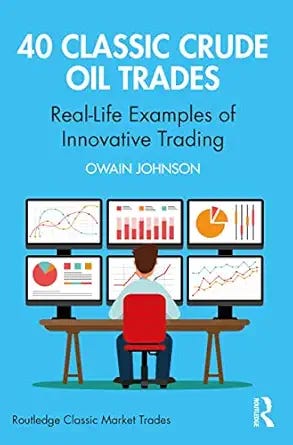
Finally, I was chatting with an oil trader about this interview and he recommended a book I immediately lifted:
Stay groovy
☮️
Need help analyzing a business, investment or career decision?
Book a call with me.
It's $500 for 60 minutes. Let's work through your problem together. If you're not satisfied, you get a refund.
Let me know what you want to discuss and I’ll give you a straight answer on whether I can be helpful before we chat.
I started doing these in early 2022 by accident via inbound inquiries from readers. So I hung out a shingle through the Substack Meetings beta. You can see how I’ve helped others:
Moontower On The Web
📡All Moontower Meta Blog Posts
👤About Me
Specific Moontower Projects
🧀MoontowerMoney
👽MoontowerQuant
🌟Affirmations and North Stars
🧠Moontower Brain-Plug In
Curations
✒️Moontower’s Favorite Posts By Others
🔖Guides To Reading I Enjoyed
🤖Resources to Get More Out of AI
🛋️Investment Blogs I Read
📚Book Ideas for Kids
Fun
🎙️Moontower Music
🍸Moontower Cocktails
🎲Moontower Boardgaming
Great speech, wonderful message. Shared with my kids.