

collar shopping
Moontower Munchies #163

Friends,
First thing…
My last post, the sound of inevitability, traveled far, with tens of thousands of reads across all channels. Not all the posts I spend a lot of time on do that, so thanks to everyone who read it.
Panoptica picked it up and formatted it much nicer than I did. You can check it out here. Matt called me to ask about the process for writing it. If you’re interested in that kind of thing and an extremely off-the-cuff (ie me being totally unpolished) discussion, here ya go:
Moving on.
At the end of July, Dean Curnutt tweeted:
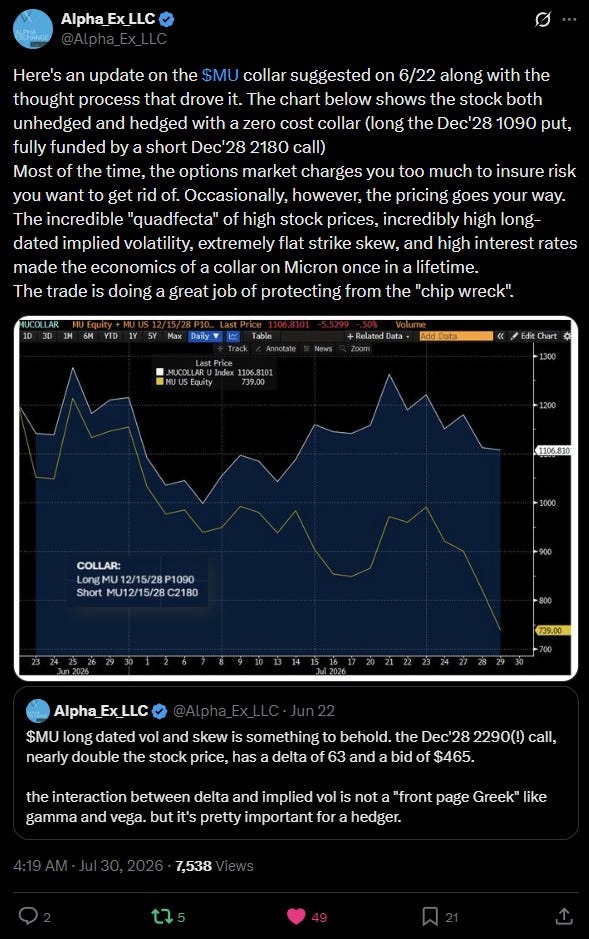
The thread should sound familiar. Weeks earlier, Dean tweeted about SNDK vols presenting attractive collar pricing for hedgers.
From high implied vol can work for or against you?:
The high vol is a gift to the natural holders. Millennial employees can lock in their unborn grandkids’ inheritance.
A non-technical way to appreciate how high vol creates this opportunity in upside call vs downside put differentials: Imagine a stock starts at $100. It gets to $125. From $125 to $150 is only 20%. But if the stock fell to $75 the distance from $75 to $50 is 33%. Both $50 and $150 are 50% from the initial price, but in a compounding sense 150 is much “closer” to the starting value than $50. The higher the vol the less “distance” a fixed dollar move represents. As implied vol increases OTM calls grow faster in value than OTM puts. This is the source of the attractive pricing you see in the risk reversal (ie option collar).
That pricing falls out of the risk-neutral world that rests on “no-arbitrage” assumptions. In fact, the lognormal return process, described in the quote without ever using the word “lognormal”, is only one of many assumptions. The forward price of the stock is also assumed to be a function of the risk-free rate, which pushes the price that the options are based on higher than the spot price. This, of course, pushes up calls and puts down by their respective deltas. These assumptions conspire to make calls look quite expensive relative to puts to someone comparing the risk-reward of options intuitively.
Intuition would likely lead to very different prices, but present an arbitrage in the process because you live in the real world not the risk-neutral world.
A few examples from that post:
Warren Buffett sells the long-dated puts because he believes the no-arbitrage assumption of the risk-free rate underestimates real-world forward prices. The option trader he faces is quite content to buy those puts since they are looking for an easy flip in the vol market.
FX carry. The speculator holds the future for the risky but generous profit the risk-neutral price creates. The derivatives trader is content to make a penny of arbitrage profit.
This is an admittedly mind-bending state of affairs, but it creates disagreement because of different horizons. This is the basis for trade!
The collars (also known as risk reversals or fences depending on the trading floor you grew up on) are another example of risk-neutral assumptions presenting wacky prices to those who don’t require arbitrage to trade.
The arbitrageur prices the collar like a contractor bidding a job. The daily hedges are materials and labor. The replication price is a manufacturing cost. Call it $500 per square foot. But the client trading the collar is looking at the finished house represented by the payoff of where the stock lands. They are happy to pay $500/ sq ft if the final product is worth $800/ft. The derivatives trader is not underwriting the final value but operating a cost plus business. They have no view on the value of the final product. It’s literally none of their business.
If you want to tangle with this deeper, you are welcome to revisit how to get arbed with perfect information (again) but take heart that you aren’t alone if you struggle with the idea of no-arbitrage replication. I always say it’s the “bridge of asses” for finance.
Collar Shopping
Dean’s tweets highlighted stocks where the calls you overwrite can finance a fairly high strike put, creating an attractive hedge and therefore risk-reward to a long position.
Consider an example where you buy a $100 stock and a 1-year 20% out-of-the-money put while selling a 1-year 40% out-of-the-money call at the same price as the put. In other words, a “zero-cost” collar. The most you can lose is 20% in the case where the stock tanks. Your upside is capped at 40% before your shares would be called away. If you think the stock has a symmetrical distribution where it’s going up or going down are the same probability this looks like a good bet because you are getting 2-1 odds.
If the collar costs $2 or 2% of the stock price, we can roll that into the basis (so $102). Now you are risking 22% to make 38%, a risk reward (R:R) of 1.73 to 1.
This is a snapshot from the Moontower Collars Workflow on 8/11/26 for options with about 3 months to expiry.
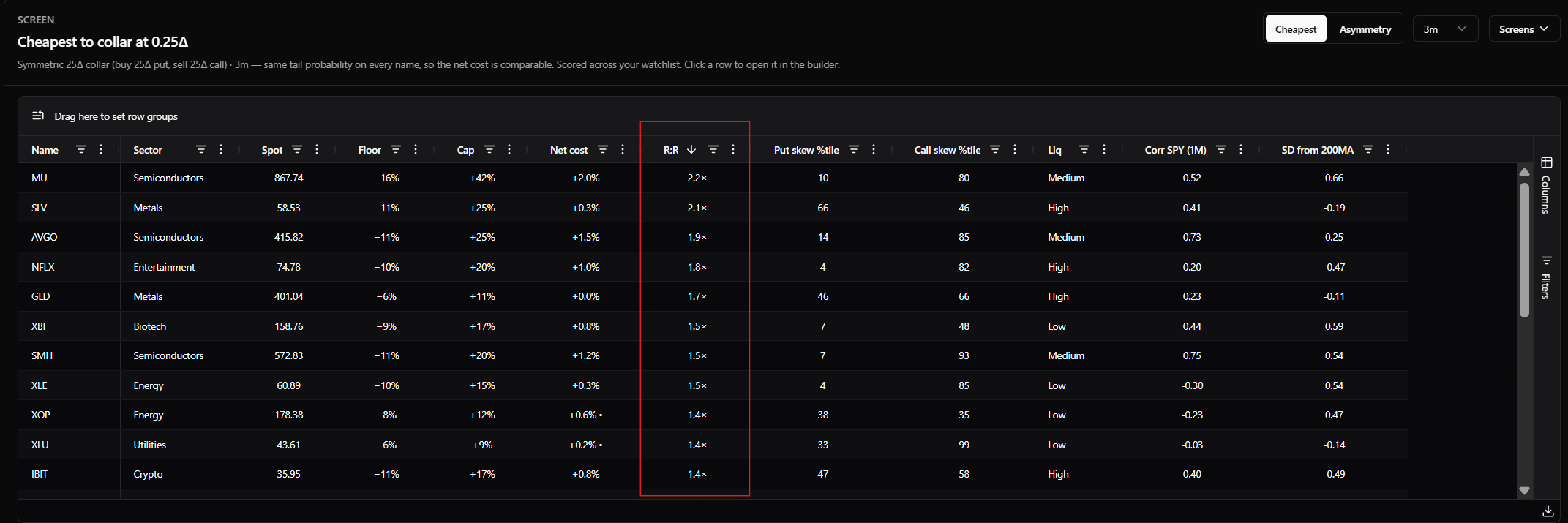
Every row on the screen prices the package of buying the .25 delta put, selling the .25 delta call, and buying the stock.
You can restrict your universe to certain sectors and re-sort. You can filter for stocks a certain threshold above their moving average or stocks that are strongly correlated to each other to hunt for the best bang for your buck for a given beta, or just any number of screens to narrow your candidates.
A thread for the masochists
The strikes here are delta-defined, so the vol gap between names is already baked in. You could imagine beta-adjusting the strikes to go a step further (although you’d need to use the API/MCP).
Beta is correlation times the vol ratio. So if correlation < 1.0, beta-adjusting pulls the call strike in toward at-the-money. You’re short that call in a collar, so a nearer strike prints fatter making the risk-reward look better. But it’s a trade-off. The result comes from truncating idiosyncratic upside that is not captured in beta.
Defensive-minded investors should take note (as Dean clearly has). The multi-year highs in deferred interest rates (pushes up forward prices) and the fact that high-flying stocks that have made concentrated investors quite rich are also relatively high-volatility presents those of us in the real (not risk-neutral) world an attractive menu of hedges.
A final puzzle for the masochists
Collared stock has the same hockey stock diagram as owning a call spread of the same strikes but the total cost will vary by some amount. How much is the amount and why? The hint lies in put-call parity. Solving this should feel like a puzzle and is a step on the “bridge of asses”.
Stay groovy
☮️
Need help analyzing a business, investment or career decision?
Book a call with me.
It's $500 for 60 minutes. Let's work through your problem together. If you're not satisfied, you get a refund.
Let me know what you want to discuss and I’ll give you a straight answer on whether I can be helpful before we chat.
I started doing these in early 2022 by accident via inbound inquiries from readers. So I hung out a shingle through the Substack Meetings beta. You can see how I’ve helped others:
Moontower On The Web
📡All Moontower Meta Blog Posts
👤About Me
Specific Moontower Projects
🧀MoontowerMoney
👽MoontowerQuant
🌟Affirmations and North Stars
🧠Moontower Brain-Plug In
Curations
✒️Moontower’s Favorite Posts By Others
🔖Guides To Reading I Enjoyed
🤖Resources to Get More Out of AI
🛋️Investment Blogs I Read
📚Book Ideas for Kids
Fun
🎙️Moontower Music
🍸Moontower Cocktails
🎲Moontower Boardgaming
Using strikes of $80 and $120:
Collared stock: min payoff $80, max payoff $120
Call spread: min payoff $0, max payoff $40
Both payoffs increase linearly between $80 and $120.
So the collar should cost more than the spread since it's the same shaped payoff but shifted up by $80:
collar = spread + gap
Expanding the terms:
put80 + stock - call120 = call80 - call120 + gap
Cancelling the short calls and re-arranging:
gap = stock + put80 - call80
By put-call parity, that right side is just PV($80): if price at expiry is below $80 you exercise your put to sell your shares at $80; if it's above, your shares are called away for $80. No matter what happens, you end up with $80 at expiration.
So, finally,
collar = spread + PV($80)
We could have also just reasoned that "same payoff shape but shifted up by $80" by no-arbitrage gives us a gap of PV($80).
So the "varying amount" is just a bond price which moves with rates and expiry. The deferred-rate highs you flag as pushing forwards up are the same r shrinking this gap.
Fun puzzle.