

37signals
Moontower Munchies #77
Friends,
Besides not being an anxious jerk on the internet, my foremost North Star is the Arnold-ism: Be useful.
The formula sits on a multi-legged stool:
Point out good stuff
Learn in public
Teach in public
If you have/develop good taste then you can be really useful doing #1 and #2.
#3 can happen as a byproduct of #1 & #2 or be a more focused effort.
[You can appear useful if you have trash taste but just try to hack people’s priors for attention. The muscular version of this is the partisan news business model embodied by MSNBC & FOX generally and Zerohedge in finance.
I’m much more forgiving of mid, vapid content because banality depends on what the viewer is brings to the table. We were all at an age where threadboi content would been enlightening even if it makes you roll your eyes today. There’s always someone turning 16 so the slop-producers don’t need to grow with their audience they can just keep selling to the same demographic. Dull maybe, but fine. Making money is mostly about being a repetitive hammer. You’re lucky if your career is also mentally stimulating.
As an aside, there is a lot of recognition today of the shortage of blue-collar trades people…the present value of a plumbing career is probably far closer to a desk job than it was in the past and in fact might even surpass many of them. I’m hearing more well-educated, white-collar parents who think they’re supposed to steer their kids’ future-career radars, observe in a “I have black friends” tone, that maybe their kids should go into the trades. This is reasonable observation except that it serves to highlight how poorly formed the questions are in the first place. Topic for another time.]
Ok, back to what I was saying…being useful on the internet. Follow the formula, people follow you. If you were interested in doing that, I’m just pointing out the simplicity (it’s not easy, but it is simple). I started out doing mostly curation, effectively arbitraging stuff-thats-boring-to-online folks but clever-to-offline folks material (ie Mungerisms). I just added my own commentary to it, often with a contrarian take or a “spot it in the wild” example to make it less abstract and more useful. (The examples from the “wild” were usually trading contexts and that’s how I discovered I knew things that were not common knowledge.)
The Guides to Reading I Enjoyed section of moontower hosts deeper dives into particular bodies of work that I’d like to reference in the future. They are foremost an act of curation, distillation, and re-factoring especially in cases where I think changing the flow is additive. Many include my commentary or links to related material that backfill the point being made.
My latest guide is about the private software company 37signals.
Specifically it’s philosophy, company culture, and procedures. A lot of it is contrarian. Some of it will remind you very much of Amazon (writing prose not bulletpoints to flesh out interconnecting logic and not just hand-wave which invites fuzzy thinking, “disagree and commit”, etc). I found it resonant enough to make a guide which I usually don’t do on company cultures. You can decide what that’s worth.
Here’s the link:
📡The Culture of 37signals (moontower guide)
Here’s the intro in full followed by an outline:
Introduction
This document is about how the company 37signals is managed.
First of all, via their homepage:
37signals is a private software company best known for making Basecamp, HEY, and ONCE; writing business and software books (Getting Real, REWORK, REMOTE, It Doesn't Have to Be Crazy at Work, and Shape Up); and inventing the Ruby on Rails framework.
Grabbing my attention
I started reading their website and was immediately pulled in. It paints a picture of a so-called “calm” company that rejects hustle culture. It does this without diluting the job-to-be done — create excellent software.
To do this, the company has clearly given tremendous thought to what conditions are required to repeatedly achieving this goal from which all growth, opportunity, profit follow. Many of its principle will be familiar to those who study Amazon’s customer-centric focus but because 37signals is a small, private, remote-first company (which has been succeeding for over 20 years itself) many of its practices might be feel more relatable and approachable.
They strike me as the kind of place that appreciates all the new-age lip-service towards being a company that serves all of its stakeholders but has found a path to doing that by being unapologetically profit-focused leading to one simple thing — delivering beautiful products that serve their customers. And to do that, in the most undistracted manner possible, they select for employees who are aligned with a culture of both craft and calm. From what I can tell, their writing intends to “find the others”.
Caveats, disclosure, and personal angle
That said, I don’t know anyone who works there. There’s no way I can know if their way of working is the source of their success. I also listen to and love the Founder’s podcast which can feel like a hagiography of maniacs (like the robber barons or Michael Jordan). I’m not pretending 37signals has found The Way to run a company. But they seem to have a found A way and that way is unconventional, contrarian, refreshing, and most of all resonant.
I started my career at SIG. As a young fish in the bowl, I couldn’t appreciate the culture they cultivated. I had no reference points and also didn’t even think about organized behavior as a matter to even consider. In hindsight, I understand how intentional the culture was. How their training and pedagogy was deeply researched and deployed.
Of course there was brainwashing. Many would use the term Kool-Aid but I don’t…
[If you understand the history of the Jonestown massacre you’ll find that drinking the suicide cocktail was anything but voluntary. The slaughter of children to destroy parents’ hope is so evil that it’s hard not to find the Kool-Aid reference to cults offensive.]
…every powerful team’s cohesion is rooted in a shared identity that flows from some mix of internal propaganda to norms of what is honorable and what is weak. As the saying goes, the poison is in the dose.
So why did I write this guide?
I simply found what I read inspirational. I like how the founders think. I like the beauty-through-simplicity of their design, their books (I’m reading Rework), and website (goated copywriting…it’s a delight to read the original sources both in form and substance).
But there’s a personal reason too.
When I started reading their stuff it reminded me so much of my friend and cofounder on moontower.ai, Emi Gal.
Emi is an extremely bright, energetic, optimistic, positive and successful entrepreneur (he built a software company in college that he exited a decade later before founding Ezra where he currently serves as CEO). As we build moontower.ai, I saw so much of the 37signals influence in him.
We’ve discussed it and indeed he’s a huge fan of them. He’s read all their books (and recommended Rework and Shape Up to me) but we also talked about how he came to many of the same conclusions while running his first company. I think that’s why reading the 37signals philosophy conjured Emi so strongly — the focused, can-do, undistracted spirit wrapped in a deep care for a holistic well-being which enables you to be excellent, rather than being at odds with professional commitment & performance.
A great hire isn’t someone decorated with credentials. That’s not a knock on credentials so much as a redirection to what matters — people who solves problems autonomously or as Emi puts it, can read a Jira (or in our case Notion) ticket and get to the finish line without needing a meeting for every clarification. Being able to do a task but understand the wider solution the task serves and course-correcting in space. In other words, thinking like a founder. The 37signals people call it a “manager of one” (described below). You can have the type of culture 37signals advocates if you select for it. And that means finding evidence for the traits you are looking for not proxy prestige accomplishments.
In the movie Boiler Room, the senior brokers warn the trainees “no writing wood”. Writing wood is the act of making lots of phone calls to pad your stats to claim you did your job but the leads generated are useless because the junior broker was anxious and tried to get off the phone instead of aggressively selling. There are lots of impressive sounding people with sterling resumes whose entire body of work is just a pile of wood. Often these smokescreen sophists will come out of prestigious place with a business so fantastic it has enough fat for useless employees to hide inside.
(It’s tempting to give credit to the cultures of highly profitable companies but if you’re a near-monopoly I’d guess it’s just as likely that a fantastic business masks a trash culture — the business might rock despite its culture. Not because of it.)
The principles laid out below strongly suggest that it’s possible to have a deeply accountable, bs-free, low politic, transparent, rewarding & remunerative culture all while preserving the balance to be excellent at work without work being your master.
If the principles sounded soft I’d accuse them of being idealistic. Instead, I see an honest approach to tradeoffs — it’s demanding in ways that lead to right answers not performative ones. More right answers = less waste.*
What to expect
I simply extracted the points I wanted to memorialize and keep as a guide although the links to the original sources are embedded. This document should serve as a convenient pointer to a bunch of 37signals writing re-factored to be linear and distilled.
I included my own comments where I felt the urge.
As you read it, it’s useful to think of how the ideas might apply or completely backfire where you work. This will either reveal an exception with their methods, or diagnose a problem with yours. Perhaps you even noticed a problem with your own organization but seeing how its handled here sparks a lightbulb moment.
*This is major cost of all the proxy measures and signaling that strangle school, work, healthcare but that’s way beyond the scope of this. I just appreciate the little crusades, like a specific company culture, that aspire to real flourishing not just its patina.
Outline
Selections from the manifesto. There’s some catchy stuff in here.
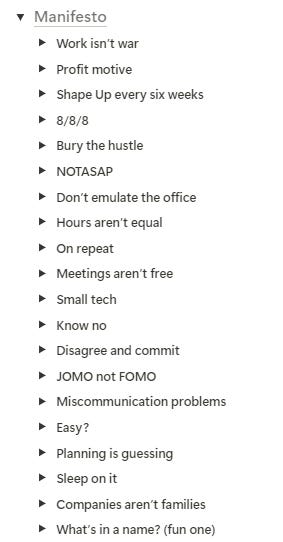
Working at 37signals
overview
what it’s like to work there
how they work
The 37signals Guide to Internal Communication
This is some of the more controversial ideas.
I broke it out into:General
Cadence
Importance of writing
How they apply the principle on a daily basis
Further reading
Why we choose profit
37signals guide to making decisions
what influence us
Group Chat: The Best Way to Totally Stress Out Your Team
It looks like a lot but it reads very quickly. The style and design of the writing is worth noting alone.

Moontower.ai is looking for help
We are looking for a part-time developer to join Emi, myself, and our backend dev Niall. It’s a remote contracting position.
Job description
We are looking for a full stack engineer with extensive experience working with RedwoodJS, Highcharts, and GraphQL. You should have 5+ years experience building data-heavy applications. The role is paid hourly and we need someone who can work with us around ~20 hrs per week.
You will work with our team to build new features and interactive analytics charts for the Moontower web app. Our app ingests a large amount of financial data from multiple APIs, runs ETLs and computations on the data, and presents it to users using 20+ proprietary charts.
Data pipelines are orchestrated using Dagster, and the downstream materialized data is queried via GraphQL into a RedwoodJS web app. We use Highcharts for charting.
Backend stack:
Python
Dagster
Postgresql
GraphQL
Frontend stack:
React
Typescript
RedwoodJS
Highcharts
We’re a small remote team working mostly asynchronously. You’ll be joining the team for a weekly sync call, with all other work done asynchronously.
If you fit the requirements reach out to us at hello@moontower.ai with the following:
Your resume and Github profile
A 1-page memo with the following brief:
“Moving to real-time”.
Moontower data is currently updated daily, with hourly data underway.
We want to move to minute / real-time data updates for all our charts. Given the tech stack outlined above, what approach would you take / what changes would you make in order to be able to easily switch our charts to real-time?
Stay Groovy
☮️
Need help analyzing a business, investment or career decision?
Book a call with me.
It's $500 for 60 minutes. Let's work through your problem together. If you're not satisfied, you get a refund.
Let me know what you want to discuss and I’ll give you a straight answer on whether I can be helpful before we chat.
I started doing these in early 2022 by accident via inbound inquiries from readers. So I hung out a shingle through the Substack Meetings beta. You can see how I’ve helped others:
Moontower On The Web
📡All Moontower Meta Blog Posts
👤About Me
Specific Moontower Projects
🧀MoontowerMoney
👽MoontowerQuant
🌟Affirmations and North Stars
🧠Moontower Brain-Plug In
Curations
✒️Moontower’s Favorite Posts By Others
🔖Guides To Reading I Enjoyed
🛋️Investment Blogs I Read
📚Book Ideas for Kids
Fun
🎙️Moontower Music
🍸Moontower Cocktails
🎲Moontower Boardgaming
37signals has been a refreshing voice of simplicity. So many people have been pumped full of (recent) VC-fueled propaganda they have no idea how companies really operate, or that they are other ways to operate (if you are independent).
DHH’s talk at startup school is also a hilarious classic: https://youtu.be/0CDXJ6bMkMY?si=S30nKLF_iddW08dn